

Last month four EBNet WG Leads met to discuss the potential for further collaboration in the field of ‘dirty’ biorefineries. This topic is interesting to many EBNet members, and lies in the space between waste treatment versus valorisation into bio-based products. The question of whether the latter is a core Environmental Biotechnology was identified and discussed in our ‘What is Environmental biotechnology?’ paper: but in practice there is a growing consensus that the distinction is not always necessary, as valorisation is essential to close the sustainability loop and help offset the costs of environmental protection.
Waste valorisation features in several new Hubs and Networks, including EBIC and C-Loop, but none of them has a direct focus on the opportunities and challenges represented by the dirty biorefinery concept. At its 4th annual conference in October 2025, our sister-NIBB BBNet asked its members which topics they would like to see taken forward after the Network funding ended. The top 13 replies included ‘integrated biorefineries’, ‘linking bioremediation to biorefining’, ‘food waste biorefining’ and ‘social and economic implications for future biorefineries’; as well as closely-related topics like scale-up in biorefining, biomass pre-treatment, fermentation, and feedstock identification and processing. Shortly before it closed, BBNet even discussed setting up an Integrated Biorefineries Working Group, but unfortunately nothing has come of this so far as we are aware.
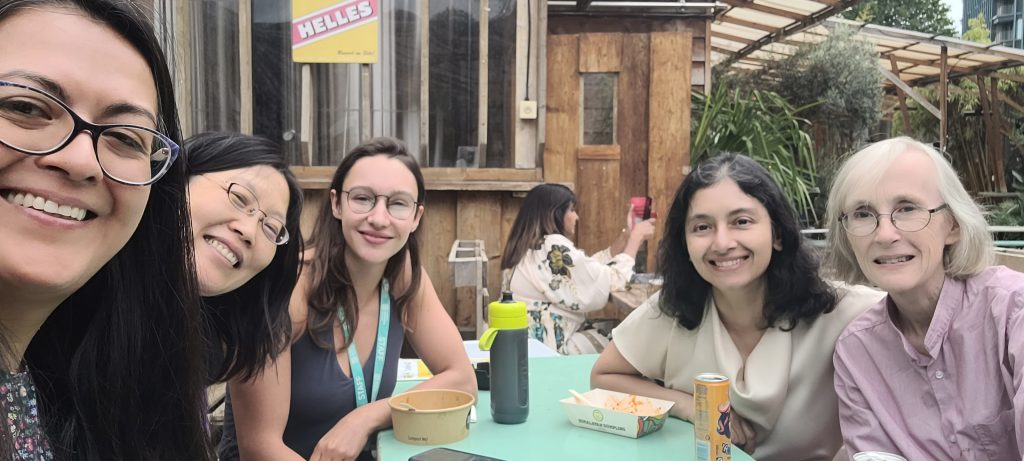
The meeting, organised by Dr Yue Zhang who co-Leads EBNet’s Anaerobic Fermentation WG, was hosted at London South Bank University by Dr Meredith Barr of the Biochar WG and attended by Dr Sharon Velasquez-Orta (Bioelectrochemical Systems WG) and Prof Jhuma Sadhukan (PISA WG and EBNet Theme 3 Champion). The four have strongly complementary scientific interests, and also span a range of career stages – from rising star Meredith to renowned international expert Jhuma. Several successful joint initiatives have already taken place between these WGs and involving other groups, including a joint workshop on Integration of Thermal and Bioprocessing led by Meredith Barr and the Anaerobic Fermentation Workshop organised by Yue Zhang. EBNet director Prof Sonia Heaven, who came along to offer support, said: “It’s great to see the energy and enthusiasm for this topic. We wish them every success taking these ideas forward into practical application!”.
L to R: Sharon, Yue, Meredith, Jhuma and Sonia at lunch after a very enjoyable meeting. (Image courtesy of S. Velasquez-Orta)