


Dr Sharon Velasquez-Orta, our Bioelectrochemical Systems WG Lead, sent this update from the EU ISMET 2026 conference – with an update on the Group’s next activities at the IWA World Water Congress, Glasgow
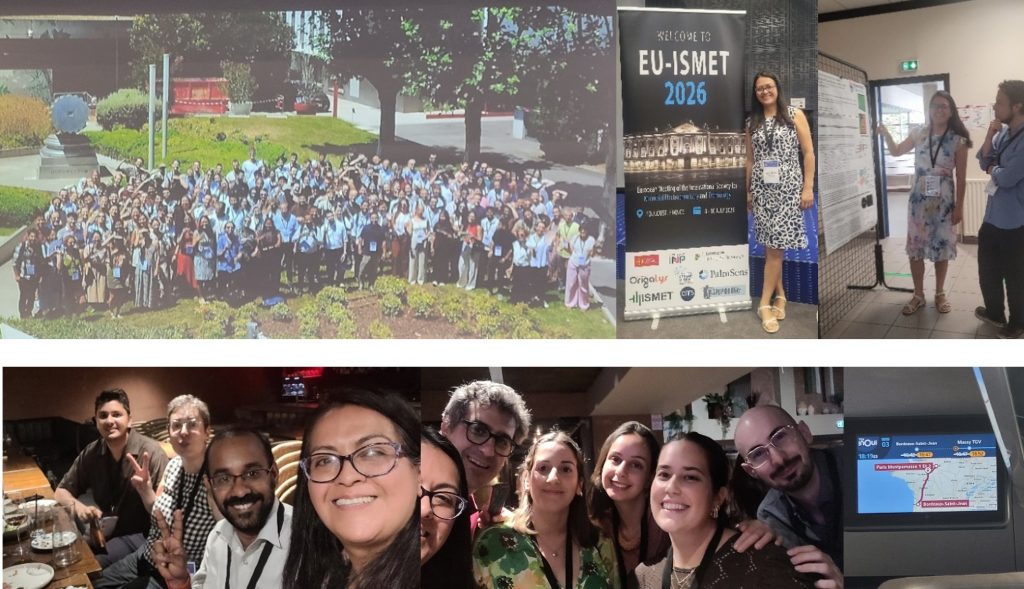
EU ISMET 2026 – join me in this conference overview, as if you were there!
The last time I attended an EU-ISMET conference was when I helped organise it at Newcastle University in 2018. After eight years, I returned as a member of the Scientific Committee and presented a poster based on our published work Life cycle assessment of microalgae-assisted microbial fuel cells.
The Conference organisers, Benjamin Erable and Jean-Marie Fontmorin, were excellent hosts and delivered a well-structured programme featuring insightful presentations and networking events at their home institution, the Chemical Engineering Research Centre in Toulouse, France.
In the middle of a heatwave, the opening keynote presentation, delivered by Marika Kokko from Tampere University, focused on the scale-up of bioelectrochemical ammonia recovery systems. The technology was scaled from 70 mL to 1 L, and then up to 105 L. The system recovered nutrients from wastewater generated by a local anaerobic plant treating sewage sludge. During optimisation, it became apparent that the most effective hydraulic residence times differed across scales, demonstrating that direct linear application of laboratory-scale results to larger systems is not always feasible: an important area for EBNet’s Theme 2.
Another proof-of-concept study was presented by Falk Harnisch from UFZ. His group demonstrated the conversion of phenol and its derivatives into cyclohexanol and aromatic intermediates using an electrochemical process. These products were subsequently converted into adipic acid and monomers in an aerobic bubble-column reactor supplied with biocatalysts, growth media, and supplementary nutrients. Hari Ananda from KAUST, Saudi Arabia, presented a pilot-scale anaerobic electrochemical bioreactor designed for energy-neutral wastewater treatment. The system incorporated solar panels to drive bioelectrochemical conversions, producing an effluent quality suitable for non-potable reuse. Researchers from IRTA, Spain, also showcased a control system designed to facilitate the operation and optimisation of pilot-scale ammonium recovery plants.
Researchers from the BioE Group at the University of Alcalá, Spain, presented the potential of electromethanogenesis for converting carbon dioxide into methane using an electrochemical fluidised-bed reactor. I particularly enjoyed engaging in insightful discussions with this group, who have a long history of developing and researching these systems. Our colleagues at LEITAT, Spain, showcased a system capable of simultaneously producing hydrogen while recovering nitrogen, highlighting the potential for integrated resource recovery approaches.
In total, the Conference brought together 184 participants from 24 countries, including 109 PhD students and early-career researchers, reflecting the strong engagement of the next generation of scientists in this field.
The Conference concluded with a plenary discussion in which participants explored how bioelectrochemical technologies might evolve over the coming years, and identified applications with the greatest potential for commercial deployment. It was encouraging to see an increasing number of pilot-scale demonstrations being undertaken worldwide, strengthening the prospects for industrial adoption and real-world implementation of Microbial Electrochemical Technologies.
What is next?
We will be chairing a session at the World Water Congress, Glasgow, as below. Let us know if you are attending so we can organise a gathering with all members from the BES WG.
TS 2.22 – Bio-electrochemical and Nanotechnology for Wastewater Treatment
Wednesday, 07 October, 10:30 – https://ebnet.ac.uk/12:00
If you would like to contribute with a story on anything related to the topic, please contact: velasquez-orta@ncl.ac.uk.
