

As if any more proof were needed of how topical Polyhydroxyalkanoates (PHAs) are, a recent paper by Prof Jhuma Sadhukhan and colleagues presents a hybrid kinetic and machine learning (ML) model to predict PHA biosynthesis performance.
The model combines ML with a dynamic, mass-balance and kinetic-based mechanistic approach to predict performance in terms of cell biomass and PHA concentrations from any strain-substrate combination, and has now been made available as open-source software (see https://jhumasadhukhan.github.io/ANN-model-to-PHA-prediction)
Prof Jhuma Sadhukhan, who leads the UK side of the Global Center for Sustainable bioproducts (GCSB), said: “Commercialisation of PHA production is currently restricted by high production costs: this approach will help screen multiple options and select the most promising for experimental optimisation”. Prof Sadhukhan also leads EBNet’s PISA WG and is a frequent collaborator with members of the AI/ML WG.
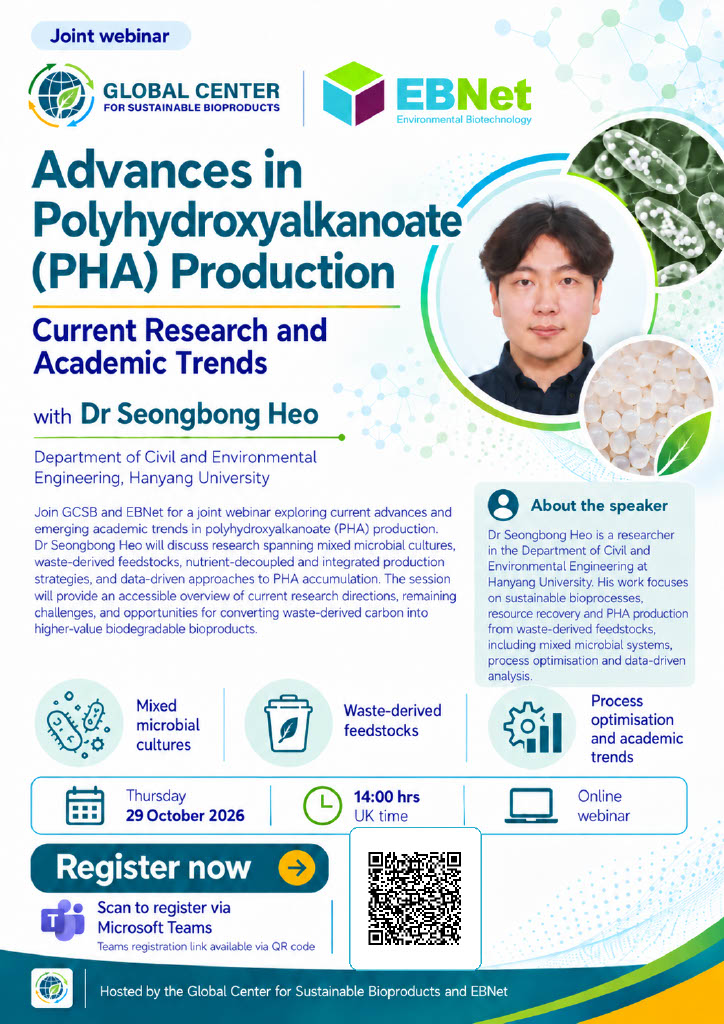
Meanwhile don’t miss the joint GCSB/EBNet webinar on PHA on 29 Oc 2026 – see here for details.