

A short video of microbial translocation along different fibres (fungal mycelium and synthetic fabric), produced as part of the EBNet-funded Fibre Highways Proof-of-Concept (POC) project, is now available HERE on our YouTube channel.
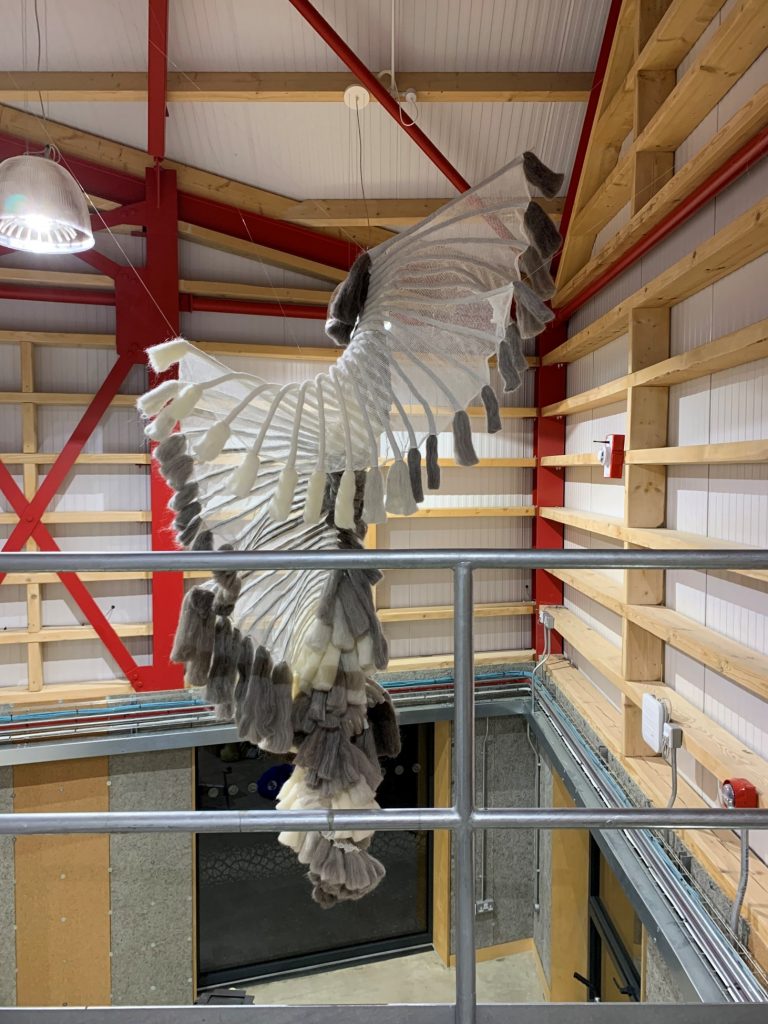
The project also provided the wonderful Ebb & Flow prototype – see image below; with an accompanying short video on the responsiveknit website. For further details see:
Biohybrids: Textile fibres provide scaffolds and highways for microbial translocation. Sherry, A., Dell’Agnese, B.M. and Scott, J., 2023. Frontiers in Bioengineering and Biotechnology, 11, p.1188965.
Fibre Highways produced environmentally responsive living textiles that unite the discipline of microbiology (Dr Angela Sherry, Northumbria University) with knit design (Dr Jane Scott, Newcastle University), to rethink and address the challenge of hydrocarbon pollution from oil spills. The approach developed a multi-kingdom textile ecosystem, using knitting as a tool for conceptual thinking, a microbial transport system and an active agent in remediation. The intention was to demonstrate how symbiotic relationships could be developed between knitted fabrics and microorganisms, and to deploy these responsive living textiles to address significant environmental challenges. Living materials (biohybrids, textile-microbial hybrids, hybrid living materials) have gained attention in recent years, with enormous potential for applications in biomedical science, the built environment, construction and architecture, drug delivery and as environmental biosensors.
Living materials contain matrices which incorporate microorganisms or biomolecules as the bioactive components. Fibre Highways took a cross-disciplinary approach, operating at the intersection of creative practice and scientific research, incorporating textile technology and microbiology to demonstrate that textile fibres can provide microbial scaffolds and highways during the study. The study evolved from previous research which showed bacteria utilising the water layer surrounding fungal roots (mycelium), termed the fungal highway, for motility. This led to the investigation of the directional dispersal of microbes across a range of fibre types (natural and synthetic) – termed Fibre Highways. The application centred around the potential for biohybrids to be used as a biotechnology to improve oil bioremediation, through seeding of hydrocarbon-degrading microbes into polluted environments via fungal or fibre highways. Furthermore, from a design perspective, textiles have huge potential to act as a conduit for water and nutrients, essential to sustain microorganisms within living materials. Using the moisture absorption properties of natural fibres, the research explored how to engineer variable liquid absorption rates using cellulosics and wool to produce shape-changing knitted fabrics suitable for adaptation to oil spill capture.
Project Findings
At a cellular scale, confocal microscopy showed that bacteria were able to utilise a water layer surrounding the fibres, supporting the hypothesis that fibres can aid bacterial translocation through their use as fibre highways. A motile bacterial culture, Pseudomonas putida, was shown to translocate around a liquid layer surrounding polyester, nylon, and linen fibres, yet no evidence of translocation was apparent on silk or wool fibres, suggesting microbes elicit different responses to specific fibre types. Findings showed that translocation activity around highways did not diminish in the presence of crude oil, known to contain an abundance of toxic compounds, in comparison to oil-free controls. Through a design lens, the growth of fungal mycelium (Pleurotus ostreatus) was demonstrated through knitted structures, highlighting the ability for natural fabrics to provide a scaffold to support microbial communities whilst retaining the ability to undergo environmentally responsive shape-change. A final prototype, Ebb&Flow, demonstrated the potential to scale up the responsive capacities of the material system using locally produced UK wool. The prototype conceptualised both the uptake of a hydrocarbon pollutant by fibres, and the translocation of microbes along fibre highways. The research moves towards facilitating the translation of fundamental science and design into biotechnological solutions that can be used in real world applications.
